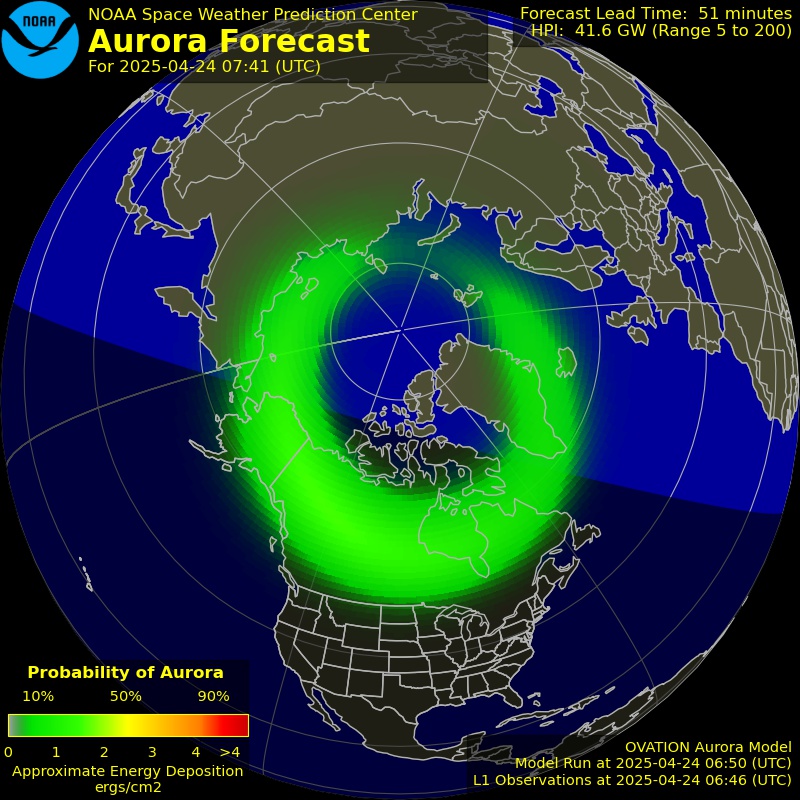
The plot below simulates the area, where
in the Northern Hemisphere an Aurora is presently visible (assuming
a dark sky). It is updated every 5 minutes but you have to click
the reload button of your browser. The model computes the estimated
brightness of auroral activity and plots this on the map as a solid
bright color that varies from green (no activity to low levels of
auroral activity) to brown/orange (low to moderate levels of activity)
to red (moderate to high levels of activity). The brighter the red,
the more intense the activity. Those areas which may be able to
spot activity are most often within the zone of fading color on
the outskirts of the plotted auroral oval. The extent of the fading
color zone on the outskirts of the oval is based on the estimated
height and intensity of auroral luminosity.
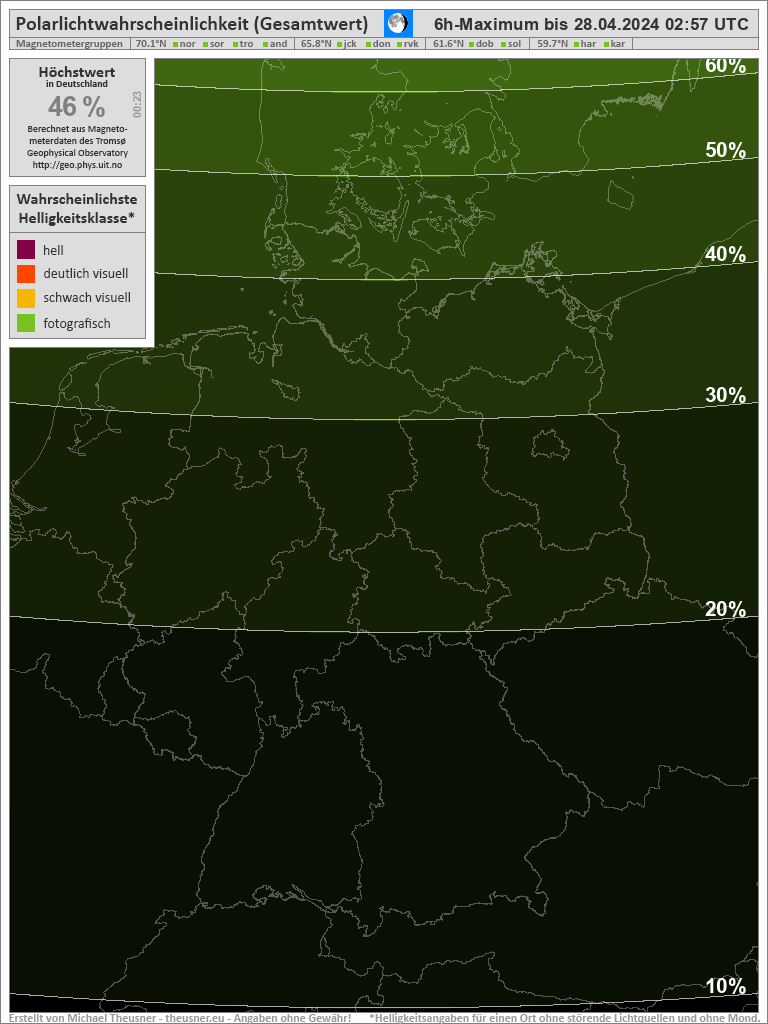
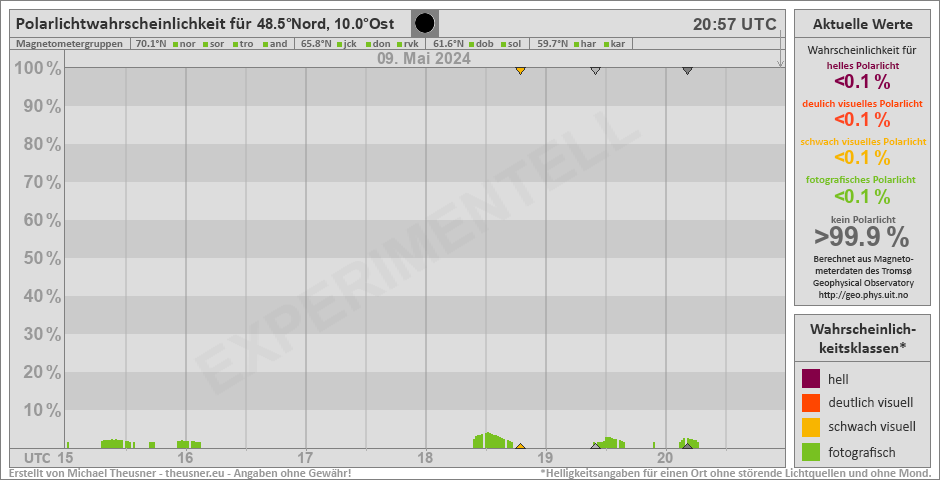
 The
map below shows, where Auroral sightings have been reported during
the last 72 hours 

Here you can see today's phase of the Moon.
Click on the right picture to get a high resolution moon map.


Here you can check which planets can be presently seen...
... and the present view and constellation
of the Moons of Jupiter, Saturn and Mars (click on the pictures
below to get the live pictures)
|
|

|
|
Jupiter's moons |
Saturn's
moons |
Mars
simulation |
Earth's
moon |

The German Astrosite astronomie.de
provides a view of the German night sky which is updated
hourly

|
|
Sky
& Telescopes Interactive Sky Chart shows you which
constellations can presently be seen

|

Schedule of Astronomy related Television transmission
of NASA:

Calculate upcoming Iridium flares
visible from the location of DD1US

(thanks to CalSky for providing
this excellent service) |
|
This
picture shows you the current position of the International
Space Station ISS  (courtesy
of ESA&Heavens-Above) |
If
you are not sure, what you have just seen then check
whether it might have been an airplane

(thanks to www.flightradar24.com) |
|
|


|