Effect |
Description |
Earth
Whistlers |
  Whistlers
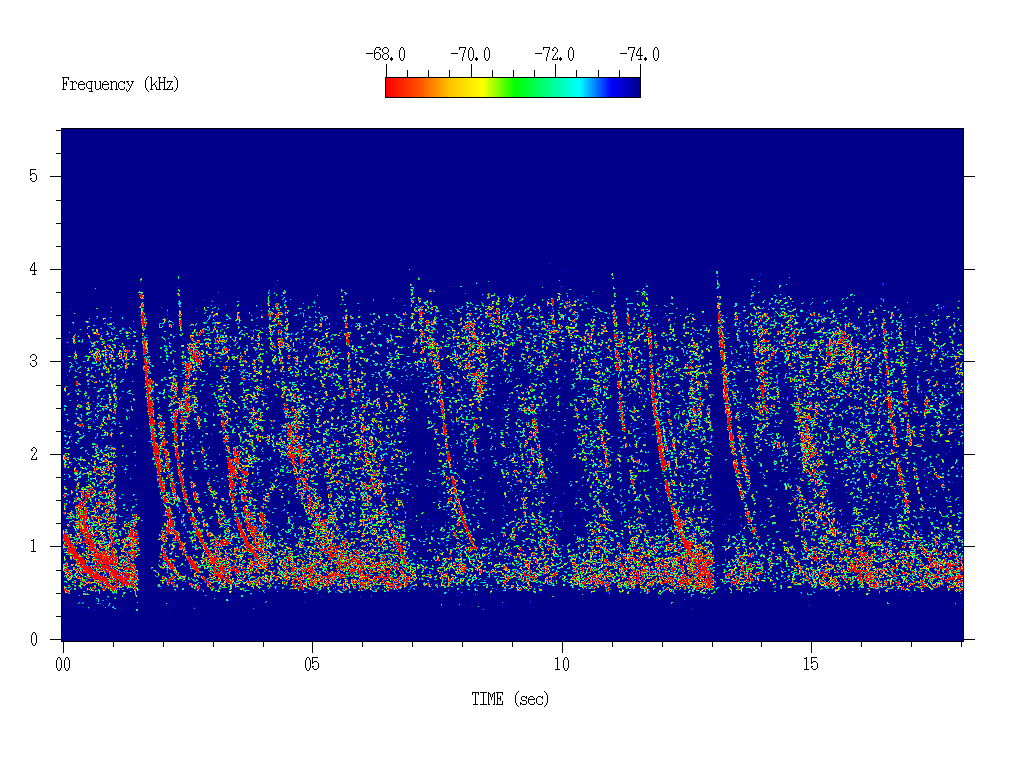
are produced by lightning and travel along Earth's magnetic
field line from one hemisphere to the other, as shown
in this illustration. In the ionized gas that exists
in this region of space, the high frequencies travel
faster than the low frequencies, thereby dispersing
the wave from the lightning stroke into a whistling
tone that decreases in frequency with increasing time,
hence the term "whistler". Whistlers
are produced by lightning and travel along Earth's magnetic
field line from one hemisphere to the other, as shown
in this illustration. In the ionized gas that exists
in this region of space, the high frequencies travel
faster than the low frequencies, thereby dispersing
the wave from the lightning stroke into a whistling
tone that decreases in frequency with increasing time,
hence the term "whistler".
Provided by
Don Gurnett from the University of Iowa.
|
Earth
Multi-hop
Whistlers |
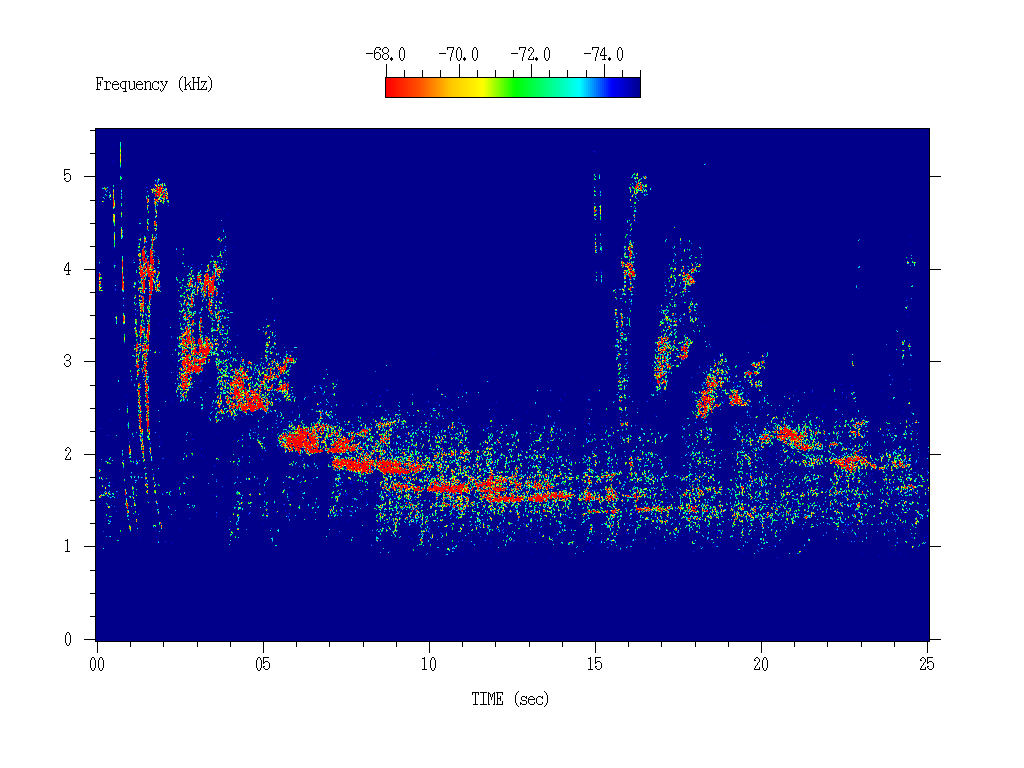
Lightning-generated
whistler waves in Earth's magnetosphere travel along
closed field lines from one hemisphere to the other.
The duration of the whistling tone can vary from one
second to as little as one tenth of a second. The duration
is related to the length of the propagation path. Each
time the whistler wave approaches the base of Earth's
ionosphere and is reflected, it travels back on a slightly
longer path.
A spacecraft traveling in the region
of whistler propagation can detect the same lightning-generated
whistler on successive reflections. The resulting sequence
of descending tones will be separated by the travel
time of the reflected wave (on the order of a second
or more). The duration of each successive tone will
become shorter as the path length becomes longer with
each reflection.
Provided by Don Gurnett from the
University of Iowa. |
Earth
Proton
Whistlers |
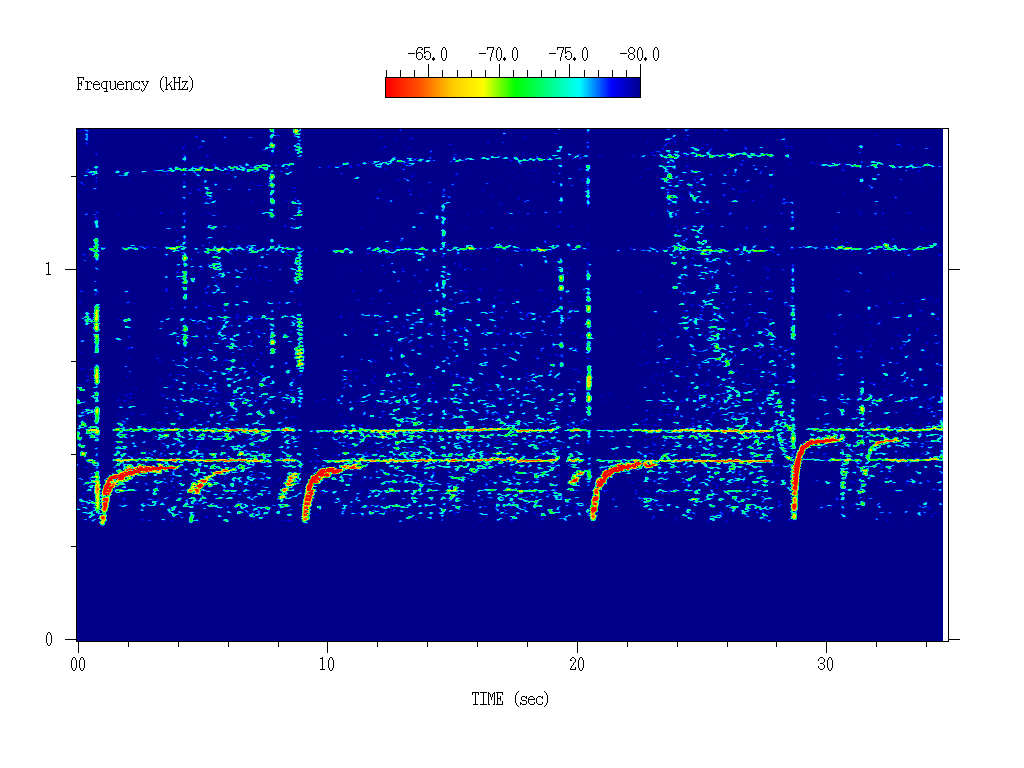
A proton
whistler can only be detected in spacecraft measurements
above Earth's ionosphere. The proton whistler will occur
immediately after an upward-propagating whistler has
been generated by a lightning discharge. It is distinct
from the more common, lightning-generated whistler both
in tone and spectral characteristics.
Unlike the
lightning-generated whistler, the proton whistler consists
of a long, slowly rising tone that begins at a low frequency
and levels off in a monotone at a frequency just below
the proton cyclotron frequency, a characteristic frequency
of the ambient plasma. The tone will typically last
several seconds.
Provided by Don Gurnett from the
University of Iowa. |
Earth
Auroral
Kilometric
Radiation
(AKR) |
Auroral
radio emissions are associated with the northern lights
or aurora. Studies, primarily using auroral imagers
and low-frequency radio receivers constructed at The
University of Iowa, have shown the aurora is caused
by energetic electrons striking the atmosphere and that
these same electrons generate intense radio emissions
over a frequency range about 100 to 500 kHz. University
of Iowa instrumentation also revealed that similar radio
emissions occur in association with aurora at Jupiter,
Saturn, Uranus, and Neptune.
Provided by Don Gurnett
from the University of Iowa. |
Earth
Chorus |
Chorus
waves in Earth's magnetosphere are generated in the
Van Allen radiation belts by electrons spiraling along
Earth's magnetic field lines in this region. Once generated,
the chorus waves interact with the moving electrons,
disturbing the spiral orbit of the electrons and causing
them to fall into Earth's upper atmosphere along the
magnetic field lines.
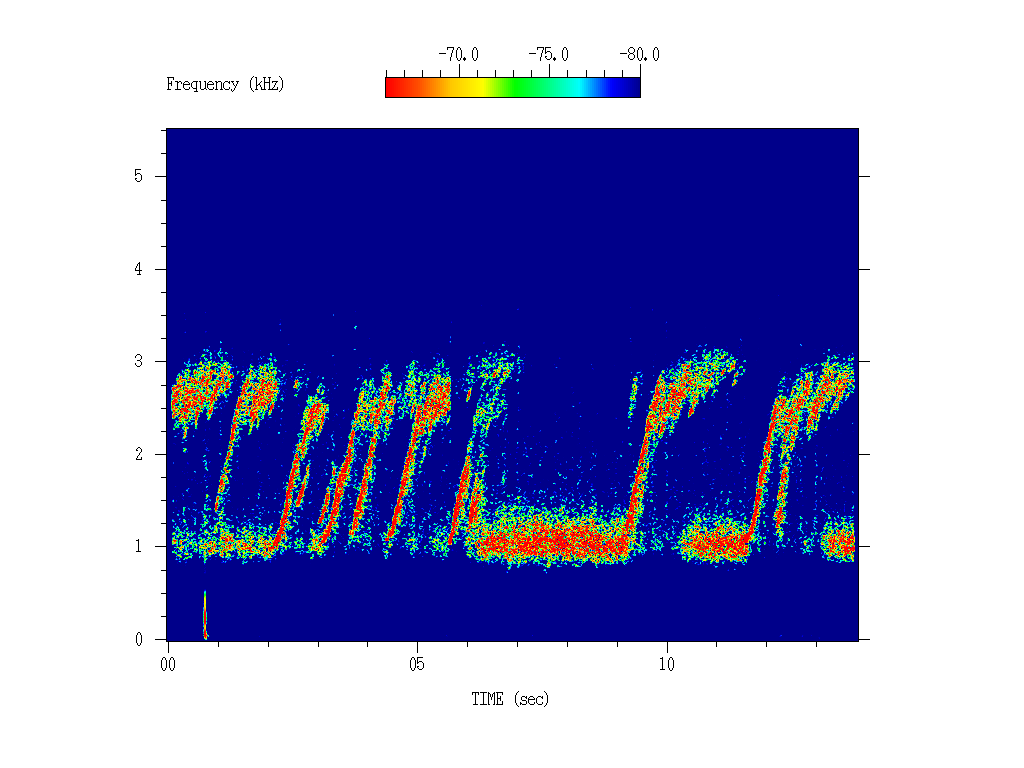
Chorus waves consist of a
rapid succession of intense ascending tones, rising
in frequency over very short time intervals, each tone
lasting typically less than one second. The frequencies
of these rising tones occur in the audio frequency range
and sound like a dawn chorus of chirping birds, a sound
which gives these waves their name.
Provided by
Don Gurnett from the University of Iowa. |
Radio Astronomy Collection
from Bob K5DZE |
Subsequently
you will find a number of recordings which are from
the late 60ies / early 70ies and which I received from
Bob Patterson K5DZE in 2010. In enclosed audio file
the narrator describes in detail the signals, frequencies
and recording processes of the various recordings. |
Pulsar 4 = CP1133 |
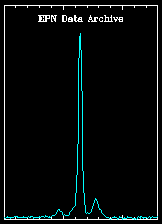
This recording
of the pulsar CP1133 was received on May 9th
1968 at Aricebo Radio Telescope in Puerto Rico. The
receiver was tuned to 111.5 MHz with a resolution bandwidth
of 300 kHz and a video bandwidth of 3 kHz. This pulsar
has a period of 1.1878 seconds. Recording kindly provided
by Bob K5DZE. |
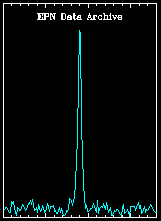
Pulsar 2 = CP0834 |
This recording
of the pulsar CP0834 was received on May 9th
1968 at Aricebo Radio Telescope in Puerto Rico. The
receiver was tuned to 111.5 MHz with a resolution bandwidth
of 300 kHz and a video bandwidth of 3 kHz. This pulsar
has a period of 1.2738 seconds. Recording kindly provided
by Bob K5DZE. |
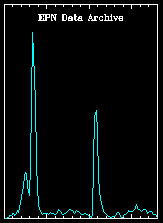
Pulsar 3 = CP0950 |
This recording
of the pulsar CP0950 was received on May 9th
1968 at Aricebo Radio Telescope in Puerto Rico. The
receiver was tuned to 111.5 MHz with a resolution bandwidth
of 300 kHz and a video bandwidth of 3 kHz. This pulsar
has a period of 0.2508 seconds. Recording kindly provided
by Bob K5DZE. |
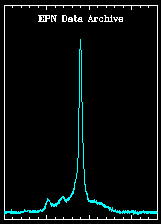
PSR B0329+54 |
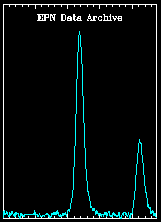
This
pulsar is a typical, normal pulsar, rotating with a
period of 0.714519 seconds, i.e. close to 1.40 rotations/sec.
Provided by Michael Kramer from the University of Manchester. |
This recording
of the same pulsar was received at the National Radio
Astronomy Observatory (NRAO) in Green Bank / West Virginia
/ USA: A dish with a diameter of 90m was used to receive
the signal at 410 MHz. Recording kindly provided by
Bob K5DZE. |
PSR B0950+08 |
This recording
of the variable type pulsar PSR B0950+08 in constellation
Antilla was received at the National Radio Astronomy
Observatory (NRAO) in Green Bank / West Virginia / USA:
A dish with a diameter of 90m was used to receive the
signal at 410 MHz. This pulsar has a period of 0.253
seconds. Recording kindly provided by Bob K5DZE. |
The Vela
Pulsar
PSR B0833-45 |
This
pulsar lies near the centre of the Vela supernova remnant,
which is the debris of the explosion of a massive star
about 10,000 years ago. The pulsar is the collapsed
core of this star, rotating with a period of 89 milliseconds
or about 11 times a second.
Provided by Michael
Kramer from the University of Manchester. |
This recording
of the same pulsar was received at the National Radio
Astronomy Observatory (NRAO) in Green Bank / West Virginia
/ USA: A dish with a diameter of 42m was used to receive
the signal at 1665 MHz. Recording kindly provided by
Bob K5DZE. |
This is
the same recording of the vela pulsar but replayed with
half the speed. This allows to listen easier to the
very interesting rhythm of this signal. Recording kindly
provided by Bob K5DZE. |
The Crab Pulsar
PSR B0531+21 |
This
is the youngest known pulsar and lies at the centre
of the Crab Nebula, the supernova remnant of its birth
explosion, which was witnessed by Europeans and Chinese
in the year 1054 A.D. as a day-time light in the sky.
The pulsar rotates about 30 times a second.
Provided
by Michael Kramer from the University of Manchester. |
PSR J0437-4715 |
This
is a recently discovered millisecond pulsar, an old
pulsar which has been spun up by the accretion of material
from a binary companion star as it expands in its red
giant phase. The accretion process results in orbital
angular momentum of the companion star being converted
to rotational angular momentum of the neutron star,
which is now rotating about 174 times a second.
Provided by Michael Kramer from the University of Manchester. |
PSR B1937+21 |
This
is the second fastest known pulsar, rotating with a
period of 0.00155780644887275 seconds, or about 642
times a second. The surface of this star is moving at
about 1/7 of the velocity of light and illustrates the
enormous gravitational forces which prevent it flying
apart due to the immense centrifugal forces. The fastest-rotating
pulsar is PSR J1748-2446ad, which rotates about 10%
faster at 716 times a second.
Provided by Michael
Kramer from the University of Manchester. |
The Pulsars
in 47 Tucanae |
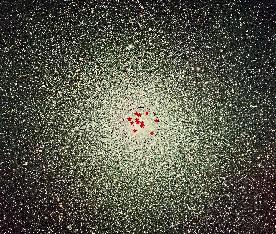
The first
sound file is a sequence of 16 of the known millisecond
pulsars followed by them all played together.
Provided
by Michael Kramer from the University of Manchester. |
The second
file is a sequence of the pulsar sounds as they fade
due to intensity variation caused by interstellar scintillation.
Provided by Michael Kramer from the University of Manchester. |
Jupiter |
This recording
of the decametric emissions of Jupiter was received
on October 3rd 1967 around
18:05 UTC at the University of Colorado in Boulder/Colorado/USA.
The receiver was tuned to 34 MHz with a resolution bandwidth
of 3 kHz. Recording kindly provided by Bob K5DZE. |
Sun |
This recording
of the decametric emissions of our sun was received
in March 1968. You hear a type 3 emission. Recording
kindly provided by Bob K5DZE. |
Sirius |
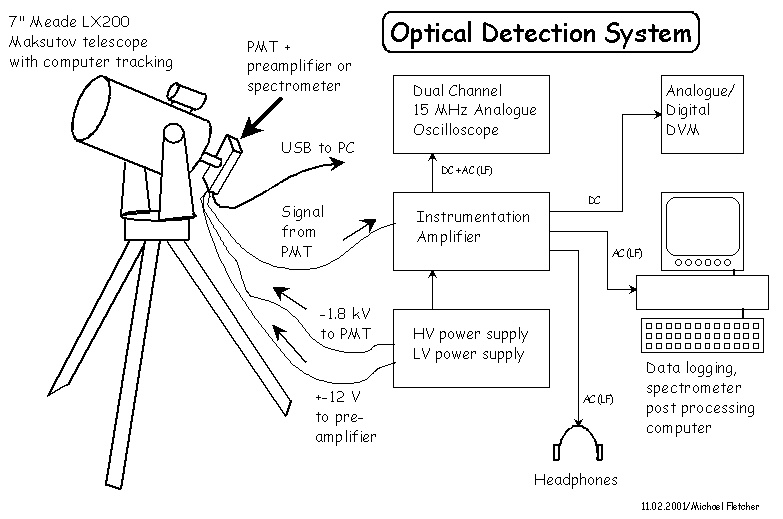
 Optical
baseband audio scintillation of the star Sirius. If
you click on the icon to the right you can see the setup
Michael OH2AUE used when recording this signal. Optical
baseband audio scintillation of the star Sirius. If
you click on the icon to the right you can see the setup
Michael OH2AUE used when recording this signal.
|
Betelgeuze |
Optical
baseband audio scintillation of the star Betelgeuze.
If you click on the icon to the right you can see the
setup Michael OH2AUE used when recording this signal. |
Uranus |
This recording
of radiowaves from Uranus is part of the compilation
"The Conquest of Space" of the Astronautical
Society of Western Australia and kindly provided by
Jos Heymann. |
Venus |
A simple sonification
of the variability of the total magnetic field during
BepiColombo’s second Venus flyby as measured by the
Mercury Planetary Orbiter’s Magnetometer (OB sensor).
The
audio spans the time range 12:00 to 14:30 UTC on August
10th 2021,
including the closest approach at 13:51 UTC. Credits
to ESA/BepiColombo/MPO-MAG/IGEP-IWF-IC-ISAS |
Mars |
This recording was
made on February 22nd 2021,
on the fourth sol (Martian day) by the SuperCam instrument
on NASA’s Perseverance rover after deployment of the
rover’s mast. Some wind can be heard,
especially around 20 seconds into the recording. Rover
background sounds have been removed. Credits to NASA/JPL-Caltech/LANL/CNES/CNRS/ISAE-Supaero. |
Mercury |
BepiColombo flew
past Mercury for the first time on October 1st 2021,
capturing data with the magnetometer onboard ESA’s Mercury
Planetary Orbiter. A sonification of the magnetic field
data is presented here. Credits to ESA/BepiColombo/MPO-MAG/IGEP-IWF-IC-ISAS. |
Mars |
NASA's Perseverance
rover has recorded the sound of lightning on Mars for
the first time, capturing 55 instances of electrical
activity through its microphone. Researchers believe
the lightning is generated by electricity from dust
storms on the planet rather than traditional weather
patterns. Credits to NASA. |